
STIHL Battery vs. Gas Power Tools: A Property Owner's Guide to Performance, Convenience, and ROI

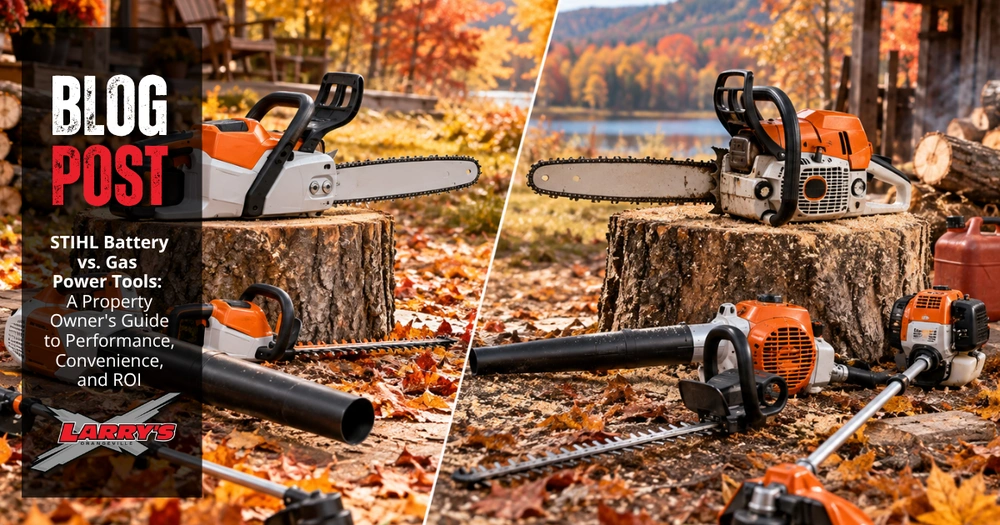
The choice used to be simple. For serious power, you reached for a gas-powered tool. But today, the hum of high-performance battery equipment is growing louder, leaving many property owners at a critical decision point. You're no longer just choosing a tool, you're choosing a technology platform for managing your property for years to come.
At Larry's Small Engines, we've spent over 40 years helping people in Mono and the surrounding communities make the right choice for their land. We've seen the evolution firsthand, and we know this isn't about which is "better," it's about which is better for you.
This guide cuts through the noise. We'll give you a clear, data-backed comparison of STIHL's legendary gas power and their rapidly advancing battery systems, so you can invest with confidence.
The Two Faces of STIHL Power
Before we compare specific tools, it's important to understand the fundamental technology you're choosing. This isn't just about fuel source, it's about how power is created and delivered.
Gas Power: The Benchmark for Raw Force
For decades, the high-revving STIHL 2-stroke engine has been the undisputed champion of outdoor power. It excels by offering incredible power-to-weight ratios and the highest energy density available. Think of gasoline as liquid power, a small tank provides a long, sustained runtime that's hard to beat. This is the technology proven on the toughest jobsites and largest properties.
Battery Power: The Rise of Smart, Stable Energy
Modern battery power is a different beast entirely. It's not just about being cordless. STIHL's Lithium-Ion systems are engineered for intelligent power delivery. The key advantage is a stable discharge curve, a battery-powered tool delivers the same high performance at 90% charge as it does at 30%. There's no fade or sputter as the energy depletes.
This isn't just a niche trend. STIHL's battery-powered products are their fastest-growing segment, accounting for 25% of total unit sales in 2024 and projected to hit 35% by 2027. This rapid adoption signals a major shift in what property owners demand from their equipment.
Head-to-Head: Where It Matters Most
Let's break down how these technologies perform in the tools you use most often. We'll look at key evaluation points to see where each platform shines.
Chainsaws: Felling Trees and Limbing Branches
|
Feature |
STIHL Battery Power (e.g., MSA 300) |
STIHL Gas Power (e.g., MS 271) |
|
Power & Performance |
Exceptional torque for clean, fast cuts. Ideal for most property tasks like limbing, felling medium trees, and storm cleanup. Consistent power from start to finish. |
Unmatched power for sustained, heavy-duty work like felling large-diameter hardwoods or bucking extensive firewood. Higher initial torque. |
|
Convenience |
Instant, push-button start. No fuel mixing, no pull cords. Lighter and easier to handle for intermittent cutting. |
Requires fuel/oil mix and pull-starting. Refueling is fast, but preparation takes time. |
|
Noise & Emissions |
Significantly quieter (60 to 70 dB), allowing work in noise-sensitive areas or early mornings without disturbing neighbours. Zero emissions. |
Louder (90 to 100+ dB), requiring hearing protection. Produces emissions. |
|
Best For |
Property owners managing 1 to 5 acres, storm cleanup, pruning, and cutting firewood from trees up to 20 inches in diameter. |
Landowners with large, wooded properties, frequent felling of large trees, or those needing maximum power for the most demanding tasks. |
Trimmers: Taming Edges and Clearing Brush
|
Feature |
STIHL Battery Power (e.g., FSA 135 R) |
STIHL Gas Power (e.g., FS 91 R) |
|
Power & Performance |
More than enough power to slice through thick weeds and overgrown grass. Quiet operation is a major plus for residential use. |
Higher torque for clearing dense, stubborn brush and saplings. Can run continuously for hours on large properties. |
|
Convenience |
Grab-and-go simplicity. Low vibration reduces user fatigue. Excellent balance and often lighter weight. |
The go-to for all-day commercial use or clearing massive, overgrown areas without needing to stop and swap batteries. |
|
Runtime |
A single high-capacity battery can handle the average suburban yard. For larger properties, having a second battery ready makes for near-continuous use. |
A tank of fuel provides extended runtime for clearing fence lines or large fields in one go. |
|
Best For |
Most residential properties, from small lots to a few acres. Perfect for regular maintenance and users who value low noise and ease of use. |
Large rural properties, professional landscapers, and clearing tough, woody vegetation where runtime and raw power are the top priorities. |
Blowers: Conquering Leaves and Debris
|
Feature |
STIHL Battery Power (e.g., BGA 300) |
STIHL Gas Power (e.g., BR 800) |
|
Power & Performance |
Impressive air volume (CFM) and speed (MPH) that can easily move large piles of dry leaves. Modern battery blowers are now tackling wet, matted leaves effectively. |
The ultimate in air-moving force. The only choice for moving vast quantities of wet, heavy leaves or debris over large areas quickly. |
|
Convenience |
Push-button start and incredibly low weight for handheld models. Backpack versions offer long runtimes with less fatigue. |
Backpack models offer ergonomic comfort for hours of use, but are heavier and produce more vibration. |
|
Noise & Emissions |
A game changer for neighbourhood relations. The low noise level means you can clear your driveway early without waking anyone up. Zero emissions. |
The loudest of all OPE. Running a commercial gas leaf blower for one hour can produce emissions equivalent to driving a car over 1,100 miles. |
|
Best For |
Clearing yards, patios, and driveways in residential settings. Ideal for properties up to several acres, especially with a backpack battery. |
Commercial operations, municipalities, and landowners with vast, heavily treed properties who need to move the most material in the least amount of time. |
Beyond Performance: The Factors That Tip the Scale
Power is only part of the equation. For a property owner, the long-term experience is just as important.
Total Cost of Ownership (TCO)
The upfront cost of a battery tool, battery, and charger can sometimes be higher than its gas equivalent. But the story changes over time.
- Operating Costs: Electricity to charge a battery is significantly cheaper than buying gasoline and 2-stroke oil.
- Maintenance: Battery tools have fewer moving parts. There are no spark plugs to replace, no carburetors to clean, and no fuel filters to clog. This means fewer trips for service and less downtime.
- Long-Term Value: Investing in a battery platform means one battery can power multiple tools, reducing the cost of expanding your shed.
The STIHL Battery Ecosystem Advantage
This is where the true value of going electric comes into focus for a property owner. STIHL doesn't just sell battery tools, they offer an entire ecosystem.
The STIHL AP System is designed for professionals and demanding property owners. A single AP battery can power your chainsaw, trimmer, blower, hedge trimmer, and more. This cross-compatibility simplifies everything. You manage one battery system, not a half-dozen different fuel cans and engine types. It streamlines your workflow and lowers the cost of acquiring each subsequent tool.
The STIHL ALLPRO System is STIHL’s professional battery platform for demanding, all-day work in forestry, landscaping, and construction. Its performance batteries use tabless cell technology to provide up to 60% more peak power than the AP 300 S, reach 80% charge in about 10 minutes with the recommended quick charger, and deliver up to 3,000 charging cycles without noticeable deterioration. The system includes batteries with different capacities and weights, ranging from the versatile AP 200 P to the higher-capacity AP 300 P C, which is designed for intensive applications and can integrate with STIHL connected fleet management.
The STIHL AK System is designed for ambitious residential yard work, offering quiet, cordless power for tasks such as trimming lawns, cutting hedges, pruning, blowing leaves, and light chainsaw work. Its three interchangeable lithium-ion batteries—AK 10, AK 20, and AK 30—provide different energy capacities so users can balance weight and runtime according to the job, while built-in LED indicators show the remaining charge. The batteries work across the AK tool range, with approximate charging times of 30-45 minutes depending on the battery and up to 1,200 charge cycles; STIHL positions the system as a flexible choice for homeowners with larger gardens or regular, more demanding projects.
The STIHL AS System, powered by the compact AS 2 battery, is intended for occasional, detail-oriented maintenance around the home, garden, garage, workshop, or vehicle. Its lightweight, easy-to-handle tools include the HSA 26 shrub shears, GTA 26 garden pruner, and SEA 20 handheld vacuum, making it suitable for shaping small hedges, trimming lawn edges, pruning branches, cutting green clippings, and cleaning small dry surfaces. The replaceable lithium-ion AS 2 battery is designed to provide reliable, consistent power in a compact format; the system’s batteries take roughly 50 minutes to charge and are intended for dry-use conditions, making AS a convenient entry-level option when portability and easy storage matter more than extended runtime or heavy-duty capacity.
The user experience with battery tools is fundamentally different. The absence of engine fumes, the dramatic reduction in vibration, and the low noise levels make yard work more pleasant.
This isn't just about comfort, it's about practicality. With quiet battery tools, your work window expands. You can get started earlier in the morning or work later into the evening without becoming a neighbourhood nuisance. For those living under noise ordinances or in close proximity to others, this is a massive advantage.
Answering Your Key Questions
When you're making a big investment, you have questions. Here are the honest answers to the most common ones we hear in our shop.
Are STIHL battery tools really as powerful as gas?
For the vast majority of property maintenance tasks, the answer is an emphatic yes. A high-end STIHL battery chainsaw like the MSA 300 will outperform many gas saws in its class for speed and torque. Gas still holds the edge for the most extreme, continuous-use scenarios, like all-day tree felling, but the power gap has effectively closed for 95% of property owners.
How long do the batteries last?
Runtime depends on the tool, the battery capacity (Ah), and the task. A high-capacity battery in a string trimmer can last 20 minutes, to an hour, while the same battery in a chainsaw under heavy load might last 25 to 45 minutes. The strategy for property owners is simple: have one battery in the tool and a second on the charger. This creates a cycle of near-continuous work. As for lifespan, STIHL batteries are engineered for hundreds of charge cycles while retaining high capacity, ensuring years of reliable service.
What about cold weather performance?
Lithium-ion batteries can be affected by extreme cold. It's best practice to store batteries indoors at room temperature. While performance may be slightly reduced in freezing temperatures, they still function well for most winter tasks. Gas engines can also be harder to start in the cold, so both technologies have considerations.
Your Property, Your Power: Making the Final Call
So, which path is right for you? It comes down to your property, your priorities, and your typical workflow.
Choose STIHL Battery Power If:
- You value convenience, low noise, and zero emissions.
- Your property is five acres or less.
- Your tasks involve regular maintenance, storm cleanup, and firewood cutting for personal use.
- You want to invest in a single, compatible system for all your outdoor tools.
- You want to reduce time spent on maintenance and fuel runs.
Choose STIHL Gas Power If:
- You have a large, rural property with demanding, all-day jobs.
- You frequently fell large-diameter trees or clear extensive, overgrown land.
- Maximum power and the longest possible continuous runtime are your absolute top priorities.
- You are comfortable with engine maintenance and have a workflow built around fuel-powered tools.
Your Next Step to the Perfect Tool
The best decisions are made with expert guidance and a hands-on feel. The specs on a page can only tell you so much. We invite you to see, feel, and compare these incredible tools for yourself.
Explore the full range of STIHL battery tools and their legendary gas-powered counterparts in our New Power Equipment section. Then, stop by Larry's Small Engines in Mono. Our team is here to understand your unique needs and help you build the perfect tool arsenal for your property.
Frequently Asked Questions
Are STIHL battery tools really as powerful as gas?
For the vast majority of property maintenance tasks, the answer is an emphatic yes. A high-end STIHL battery chainsaw like the MSA 300 will outperform many gas saws in its class for speed and torque. Gas still holds the edge for the most extreme, continuous-use scenarios, but the power gap has effectively closed for 95% of property owners.
How long do the batteries last?
Runtime depends on the tool, the battery capacity (Ah), and the task. A high-capacity battery in a string trimmer might last over an hour, while the same battery in a chainsaw under heavy load might last 25 to 45 minutes. STIHL batteries are engineered for hundreds of charge cycles while retaining high capacity.
What about cold weather performance?
Lithium-ion batteries can be affected by extreme cold, so it's best practice to store them indoors at room temperature. Performance may be slightly reduced in freezing temperatures, but battery tools still function well for most winter tasks. Gas engines can also be harder to start in the cold, so both technologies have considerations.