Lynx vs. Ski-Doo: Which Sled Actually Suits an Ontario Rider?

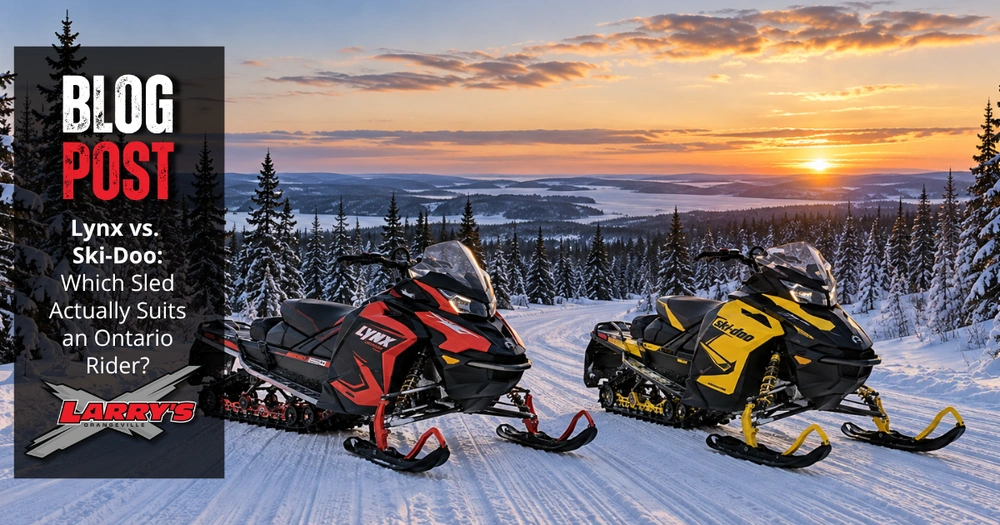
Ski-Doo and Lynx snowmobiles are both built by BRP, but they are set up for different snow. Ski-Doo is tuned for the groomed trail systems that make up most North American riding. Lynx is engineered in Finland for rough, un-groomed backcountry. For most Dufferin County riders, that difference decides the purchase before you ever look at a spec sheet.
Get it wrong and you spend the season fighting your sled: a backcountry-tuned suspension feels harsh on a smooth groomed trail, and a short trail track feels helpless the moment you leave one. This guide covers the brand split, the three sled categories, the 2-stroke versus 4-stroke question, and what the new 600RR E-TEC engine changes for 2027.
What Is the Difference Between Ski-Doo and Lynx?
Lynx is BRP’s Scandinavian snowmobile brand, built in Rovaniemi, Finland, and sold in North America since 2022. It shares Rotax engines and core chassis engineering with Ski-Doo, then diverges on suspension, ergonomics and calibration. Lynx uses the PPS3 rear suspension family, a taller seat and a stand-up-friendly riding position built for terrain that is never groomed.
Ski-Doo builds for the opposite reality. Most Ontario riding happens on marked, groomed club trails, so Ski-Doo’s trail models are calibrated for seated comfort, predictable cornering and high-speed stability on packed snow. Both are premium machines. They just answer different questions.
TL;DR
- Ride groomed trails. A Ski-Doo trail or crossover sled with a 129 to 137 inch track is the default right answer in Dufferin County.
- Ride off-trail, hard. Lynx earns its price when the snow is deep, rough and un-groomed, and when you ride standing up.
- The 600RR E-TEC is the 2027 headline. 130 hp, 8,250 rpm, roughly 20 percent quicker throttle response than the 600R it replaces.
- Two-stroke still wins the trail. Lighter and snappier, which matters more than peak horsepower on tight Ontario trails.
- Track length is the real decision. Trail, crossover and utility sleds differ far more in track and suspension than in badge.
Trail, Crossover or Utility: Match the Sled to the Riding
Snowmobile categories are defined by track length, lug height and suspension travel, not by marketing. Here is how the three categories that matter in southern Ontario compare.
|
Sled type |
Track length |
Lug height |
What it does best |
Best for |
|
Trail |
129-137 in |
1.25 in - 1.5 in |
Cornering and stability on packed, groomed snow |
Riders who stay on marked OFSC trails |
|
Crossover |
146 in -154 in |
1.5 in - 2.5 in |
Trail speed plus flotation in ditches and fields |
Riders who leave the trail most outings |
|
Utility |
137 in - 154 in (up to 24 in wide) |
1.25–2.25 in |
Hauling, towing, and breaking trail |
Farms, camps, bush lots and cottage access |
You can see the split clearly on our own showroom floor. The 2027 Ski-Doo Skandic Sport 600 EFI runs a 154 inch track and a 556 lb dry weight, which is a working sled for bush lots and unbroken snow. A 2027 MXZ Sport 600 EFI on a 129 inch track sits at 436 lb dry. Same engine family, 120 lb apart, two completely different jobs.
2-Stroke vs. 4-Stroke on Dufferin County Trails
This debate gets treated as a personality test. It is not. It is a weight and duty-cycle question.
|
Factor |
2-stroke |
4-stroke |
Who it favours |
|
Weight |
Roughly 436 lb dry on a 129 in in track |
Typically 50–100 lb heavier in the same class |
Two-stroke, for tight trail riding |
|
Throttle response |
Instant hit, strong mid-range pull |
Smoother, more linear delivery |
Two-stroke, for technical trails |
|
Fuel and oil |
Burns oil, must be topped up |
No oil injection, longer service intervals |
Four-stroke, for long touring days |
|
Peak horsepower |
Up to 180 hp in turbo two-stroke form |
Up to 180 hp turbo, more headroom |
Four-stroke, for big-power builds |
|
Noise and heat |
Sharper exhaust note, less engine braking |
Quieter, strong engine braking |
Four-stroke, for shared trail systems |
For a Dufferin County rider doing 100 to 200 km weekends on club trails, the two-stroke wins on the strength of weight alone. Four-stroke makes sense when you are covering long distances, riding two-up regularly, or want the quieter machine for early-morning starts near neighbours.
What the New 600RR E-TEC Changes for 2027
The 600RR E-TEC is a 130 hp Rotax two-stroke that replaces the 600R E-TEC for model year 2027. It adds 5 hp, lifts the rev ceiling 150 rpm to 8,250 rpm, and uses race-derived booster injectors that BRP rates at roughly 20 percent quicker throttle response. It also drops oil consumption about 20 percent and adds a smart ECO mode for fuel savings.
On the Lynx side, the 600RR lands in the Rave RE, including the 20th anniversary edition running PPS³ rear suspension with KYB PRO 46 HLCR Kashima shocks. On the Ski-Doo side it spreads across various MXZ models, Renegade Adrenaline with Enduro Package, Backcountry Adrenaline, Summit Adrenaline, Expedition LE and Skandic LE.
If you want to see what that combination feels like, the 2027 Lynx Rave RE 600RR E-TEC is arriving at our Mono showroom. It is the clearest example of the Lynx philosophy: race-bred engine, suspension built to absorb punishment rather than glide over corduroy.
Which Sled Suits Your Riding?
You ride groomed club trails and stay on them
Buy a Ski-Doo trail sled on a 129 or 137 inch track. The 600 EFI is the value play, the 600RR E-TEC is the performance play, and the 850 E-TEC is for riders who want the extra pull, ride two-up or travel fast on long straight aways.
You ride trails but drop into ditches, fields and bush
Buy a crossover. A 137 to 146 inch track with a taller lug gives you trail manners without stranding you the moment you leave the packed line. This is the fastest-growing category in our area for a reason. Ski-Doo is great for this, but Lynx is best. It's just a more aggressive ride.
You work your sled
Look at a utility sled like the Skandic, If your winter involves hauling firewood, checking a bush lot, or riding snow nobody has groomed, the Scandinavian setup stops being a novelty and starts being the right tool.
You ride genuinely rough terrain
Look seriously at Lynx crossover models. Lynx snowmobiles eat up rough conditions.
You can compare the current lineup side by side in our snowmobile inventory, which lists engine, track length and dry weight on every unit so you can filter on the specs that actually decide the purchase.
Frequently Asked Questions
Is a Lynx better than a Ski-Doo?
Neither is better, they are tuned for different snow. Lynx is engineered around rough, ungroomed Scandinavian terrain and a standing riding position, while Ski-Doo is set up for the groomed trail systems that make up most Ontario riding. Both are built by BRP and share Rotax engines and a lot of chassis engineering, so the decision comes down to where and how you actually ride.
Can you buy a Lynx snowmobile in Ontario?
Yes. Lynx came to North America in 2022 and is sold through select BRP dealers, including Larry’s Small Engines in Mono. Availability is limited compared to Ski-Doo, and most Lynx units are ordered rather than pulled off the floor, so early ordering matters more than it does with Ski-Doo.
What is the new 600RR E-TEC engine?
The 600RR E-TEC is a 130 hp two-stroke Rotax that replaces the 600R E-TEC for model year 2027. It adds 5 hp, raises the rev ceiling by 150 rpm to 8,250 rpm, and uses race-derived booster injectors for roughly 20 percent quicker throttle response. It also runs a smart ECO mode and uses about 20 percent less oil.
Is a 2-stroke or 4-stroke snowmobile better for trail riding?
For most Ontario trail riders, a modern 2-stroke is the better fit. It is lighter, snappier off the throttle, and easier to flick through the tight, twisty sections common on Dufferin County trails. Four-strokes make more sense for high-mileage touring, quiet operation, and turbocharged high-horsepower builds.
What track length do I need for Ontario trails?
A 129 to 137 inch track covers most Ontario trail riding. Shorter tracks are quicker to turn and lighter, longer tracks add flotation and hookup when the trail gets chewed up or you drop into a ditch line. Go to 154 inches or more only if you are hauling, breaking trail, or riding deep off-trail snow.
Do I need a trail permit to ride in Dufferin County?
Yes. Riding on OFSC prescribed trails in Ontario requires a valid Ontario Snowmobile Trail Permit displayed on the sled, in addition to registration and insurance. Permits are sold through the Ontario Federation of Snowmobile Clubs, and buying before the early-season deadline is cheaper than buying in January.
Action Steps
- Define your ride mix first — write down the percentage of your season spent on groomed trail versus off it, then pick the category before the brand.
- Compare dry weight, not just horsepower — on tight Ontario trails, 100 lb of weight changes the ride more than 15 hp does.
- Order early if you want a Lynx — North American allocation is limited and most units are spoken for well before the snow flies.
- Buy your trail permit before the early-season deadline — the Ontario Federation of Snowmobile Clubs prices full-season permits lower ahead of the cutoff.
- Book a demo at the Mono showroom — sitting on a 129 and a 154 back to back settles the question in about ten minutes.